Marshalling the Margins: Why Yard Flow Is Scottish Warehousing’s Next Capacity Frontier
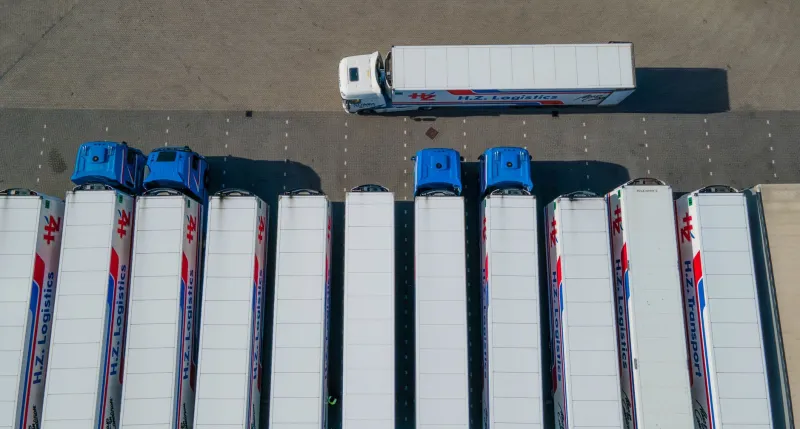
Warehouse operators are accustomed to measuring performance inside the building: pick rates, dock-to-stock times, inventory accuracy and labour utilisation. The yard, by contrast, is frequently treated as a holding area rather than a managed process. That assumption is becoming harder to sustain. In 2026, as Scottish sites handle more varied delivery profiles and tighter customer expectations, the space before the dock leveller is emerging as a genuine capacity frontier.
The yard as a constrained system
A distribution centre does not begin at the goods-in door. It begins at the gate. Trailer parking, HGV queuing, gatehouse checks, marshalling and driver facilities all shape how quickly vehicles reach a bay and how predictably they leave. When these elements are poorly coordinated, the consequences surface inside the warehouse as idle dock doors, uneven labour demand and avoidable demurrage.
The difficulty is that yard capacity is rarely measured with the same rigour as racking capacity. A site may know exactly how many pallet positions it holds, yet have only a rough sense of how many trailers it can absorb without blocking access roads or neighbouring premises. That gap matters in Scotland, where many warehouses sit on constrained plots close to urban boundaries or on rural sites served by single-carriageway routes.
Booking slots that reflect operational reality
Appointment systems are only useful if they reflect what the yard can actually process. A booking grid built around ideal arrival times will quickly collapse when suppliers, hauliers and collection customers arrive early, late or in clusters. The resulting queues are not simply an inconvenience; they consume driver hours, create safety risks and undermine the credibility of the gatehouse.
Operators should review slot granularity against real dwell times rather than contractual assumptions. Some sites benefit from wider arrival windows and explicit marshalling instructions; others need tighter slots supported by live visibility and clear escalation routes. The objective is not to punish variability but to expose it early enough for the yard team to respond. During peak periods, a modest buffer between slots can be more valuable than a fully compressed schedule that leaves no room for recovery.
Gatehouse control and marshalling discipline
Gatehouse controls are often viewed as an administrative function, yet they are the first point at which yard flow can be won or lost. Number plate recognition, pre-arrival documentation, safety briefings and trailer checks all take time. If these tasks are handled inconsistently, vehicles accumulate at the barrier and the yard loses its rhythm.
Marshalling discipline is equally important. Clear instructions on where to park, where to wait and when to reverse onto a bay reduce confusion and improve safety. Segregating pedestrian routes, marking trailer parking bays and maintaining visibility at blind corners are basic measures, but they are frequently compromised when demand rises. A yard that works well on a quiet Tuesday can become congested on a busy Thursday if overflow parking has not been planned and communicated.
Making limited land work harder
The most common Scottish constraint is not a lack of willingness to improve the yard but a lack of land. Sites in the Central Belt may face high land values and planning restrictions, while rural operations may be bounded by access roads, drainage constraints or neighbouring agricultural use. In these circumstances, the answer is rarely simply to add more spaces.
Operators can instead examine trailer dwell time, the ratio of allocated parking to active movements, and the potential for short-stay collection bays. One-way systems, marked overflow zones and staggered arrival patterns can release capacity without construction. Where land is genuinely unavailable, shared or offsite marshalling arrangements may be worth exploring, provided responsibility and communication lines are unambiguous. For rural sites, access constraints demand particular attention: passing places, weight restrictions and community impact should be part of the planning conversation, not an afterthought.
Driver facilities as an operational asset
Driver welfare is sometimes treated as a separate concern from throughput. In practice, the two are connected. A driver who has no access to toilets, waiting shelter or clear information is more likely to seek assistance at the gatehouse, park unpredictably or escalate delays. Facilities do not need to be elaborate, but they should be clean, accessible and clearly signposted.
Good facilities also support safety. Waiting drivers should have a designated area away from reversing trailers and moving plant. Communication screens or printed instructions can reduce unnecessary movement. These measures are modest, but they signal that the yard is a managed environment rather than an unstructured car park.
Planning for peak-season surge
Peak planning often concentrates on labour and stock. Yard capacity deserves equal attention. A pre-peak review should test whether booking profiles, trailer parking and gatehouse staffing can absorb the expected surge. Temporary measures, such as extended gate hours or overflow marshalling, should be agreed in advance with hauliers and neighbours.
Weather adds a further dimension in Scotland. Winter conditions can slow vehicle movements, close rural routes and increase dwell times. A surge plan that assumes normal travel conditions is incomplete. Contingency arrangements for delayed arrivals and early departures should be built into the schedule.
A practical starting point
The first step is measurement. Record arrival times, gate-to-bay times, dwell durations and peak queue lengths over a representative period. Map vehicle and pedestrian movements, and identify where conflicts occur. From there, pilot one or two changes, such as revised slot windows or marked overflow parking, and review the effect before extending them.
The warehouse will always command attention because that is where the product is handled. But in 2026, Scottish operators cannot afford to treat the yard as a passive margin. Gate flow, trailer parking and marshalling are part of the operating system. Managing them with the same discipline applied inside the shed is a practical route to releasing capacity without extending the building.