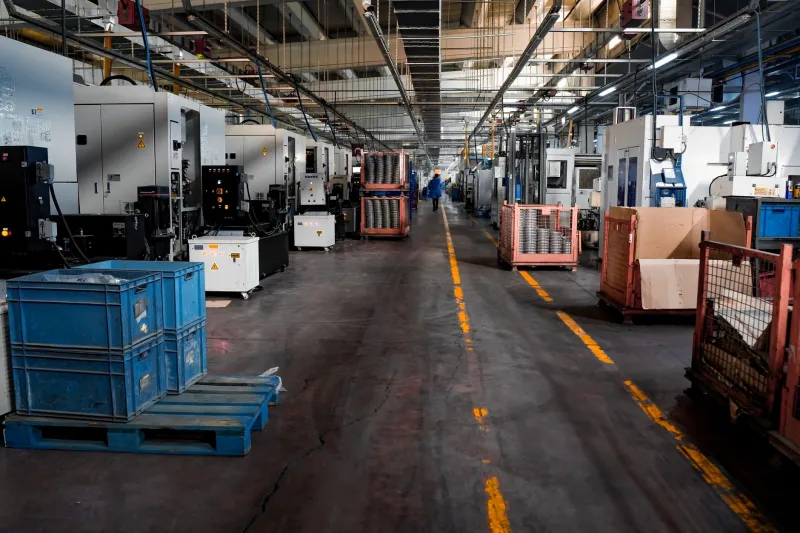
From Wrapper to Record: Where Packaging Compliance Really Lives in a Scottish Warehouse
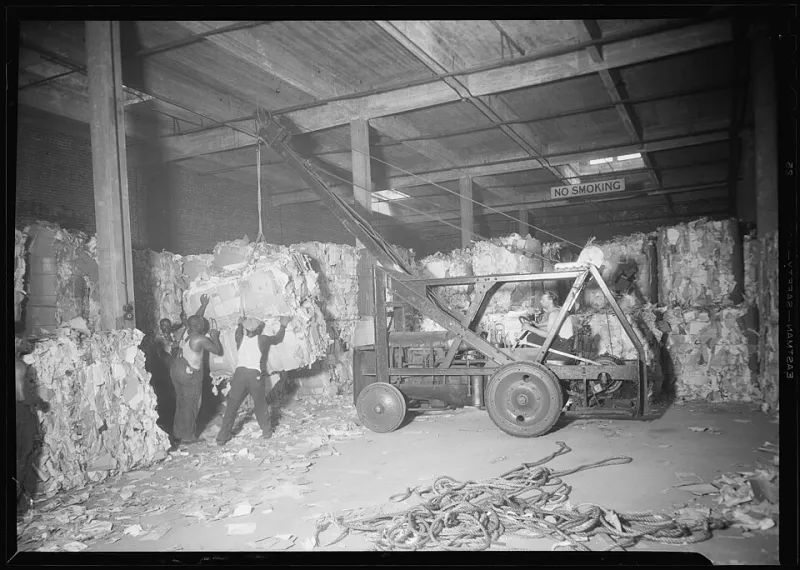
Photo: Lewis Hine, Public domain, via Wikimedia Commons
Packaging has quietly become one of the most heavily documented materials passing through a Scottish warehouse. Under the UK's extended producer responsibility regime for packaging, the tonnages that determine a company's fees are compiled by material and by activity — and a meaningful proportion of those figures originate at the goods-in desk, on a pallet, beneath a stretch hood. Alongside that, the steady tightening of workplace recycling duties means the same site is now expected to separate, store and evidence the onward journey of everything it unwraps.
The practical consequence for Scottish operators is that compliance has migrated out of the accounts function and onto the warehouse floor. Treat it as a paperwork exercise bolted onto existing routines and it will eventually fail an audit. Treat it as an operational process, with space, labour and evidence attached, and it becomes governable.
What the regime now asks for
The obligations are structured around thresholds. Organisations above the large-producer line — broadly, turnover over two million pounds and more than fifty tonnes of packaging handled in a year — both report data and pay fees. A lower band reports data without paying, and even modest importers can find themselves captured. The critical distinction for warehousing is activity: a site that imports own-label goods is not merely a distributor, it is the importer, and the obligation travels with the goods.
Nation-level reporting adds a further layer. Packaging supplied into Scotland must be identifiable as such, which means a warehouse despatching across the UK needs reasonable attribution rather than a single blended figure. On the recycling side, England's Simpler Recycling requirements and Scotland's own separation duties for businesses — long established under the Waste (Scotland) Regulations and reinforced by newer circular economy legislation — do not always align. Cross-border operators should resist the assumption that one standard travels neatly across the border.
The goods-in record is the primary source
Most packaging data failures begin at receipt. A supplier delivers on a pallet with a specification sheet that lists component weights, and nobody captures it; the pallet is broken down, the packaging is baled, and the tonnage becomes an estimate. Twelve months later that estimate is the basis of a fee.
The remedy is unglamorous. Packaging specifications should be requested at supplier onboarding and held against the product record. Where specifications are unavailable, a sample-weighing routine for the highest-volume lines will produce a defensible average. One named individual should own the packaging dataset, in the way that another owns stock accuracy, and the data should be reviewed alongside inventory rather than at year end.
Space, plant and the bale store
Compliance consumes floor area. Balers need a footprint, a power supply and a safe working zone. Bales need somewhere to sit between collections, and that storage point is often the last unplanned corner of a warehouse — beside a fire exit, under a mezzanine, against a wall shared with the office.
That is a mistake on more than one count. Baled cardboard and film are combustible, and insurers increasingly ask where they are kept, how far they are from ignition sources and how quickly they are removed. Bale storage also attracts pests and degrades if exposed to weather. A site that schedules collections against actual bale production, rather than a fixed weekly slot, will need less space and fewer awkward conversations.
Contamination is a cost, not a nuisance
Mixed material in a bale reduces its value and, in some arrangements, triggers a rejection charge. Tape left on corrugate, film with paper labels, and the perennial problem of expanded polystyrene in the wrong stream all erode the economics of a recycling contract. Segregation at the point of unpacking is far cheaper than sorting at the baler, but it requires bins in the right places, signage in the right languages and a supervisor willing to challenge habits.
Takeback and the evidence trail
Supplier takeback arrangements — where packaging returns on the inbound vehicle — are attractive because they remove material from the site entirely. They still require documentation. Waste transfer notes, carrier registrations and duty-of-care checks apply as they would to any third-party collection, and the arrangement should be written into the supply agreement rather than left to a verbal understanding between two drivers.
Reporting to customers without guesswork
Retail and e-commerce customers increasingly ask suppliers for packaging data at order or contract level. A warehouse that has captured component weights at goods-in can answer those questions from a system; one that has not will revert to averages and caveats. The difference is credibility, and increasingly it is a commercial differentiator in tenders.
A workable routine
- Capture packaging specifications at supplier onboarding and hold them against the product record.
- Sample-weigh high-volume lines where specifications do not exist, and record the basis of the estimate.
- Map baler and bale-storage positions against fire compartmentation and insurer requirements.
- Place segregation bins at unpacking points, not at the baler.
- Review waste transfer notes monthly, not annually.
- Attribute despatches to nation so that Scottish volumes can be evidenced.
The warehouse was never simply a place where packaging waited. In 2026 it is where packaging is measured, and the quality of that measurement now has a price attached.